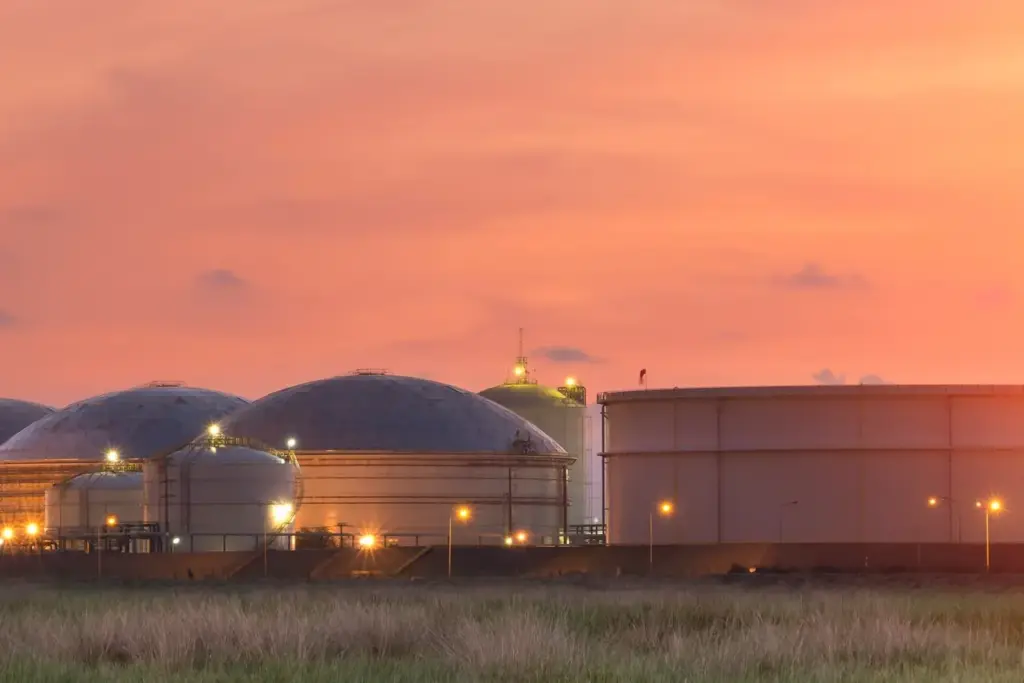
Bulk liquid storage tanks are vital assets across many industries—from oil and gas and water treatment, to energy from waste (EFW) and chemicals. However, maintaining their integrity and protecting the stored product through an effective protective lining is no small feat.
What is a Tank Lining?
A tank lining is a specialist coating or membrane applied to the storage tank’s internal surfaces. There are a wide variety of tank lining systems each designed for a certain application or requirement, from the versatile epoxy phenolics and novolacs, to chemical resistant vinyl esters, polyurethanes, polyureas, rubber, glass flake reinforced, glass fibre reinforced, laminates to name just a few!
Why are Tank Linings used?:
1. Corrosion protection / chemical resistance: a tank lining prevents rusting, pitting and structural failure of the steel storage tanks. This is particularly important when storing aggressive cargoes such as acids, solvents and even water.
2. Product quality: a tank lining can enhance product quality, for example in jet fuel / aviation fuel tanks a lining system with a smooth, seamless finish can ensure that water droplets do not collect on imperfections of the coating and cause contamination of the fuel.
3. Hygiene and Safety: a tank lining can stop leaching or contamination which is critical in food, beverage, potable water.
4. Environmental compliance: a tank lining prevents leaks / spills that could contaminate local soil or groundwater.
5. Cost savings: repairing an old tank with a new tank lining system can be far cheaper than replacing the tank. Also a well maintained tank with a suitable lining system can help you avoid costly downtime and outages resulting from structural failure of the tank.
Why are Tank Linings so Challenging?
🔹Tank linings are amongst the most challenging applications within the protective coatings field due to the highly technical application requirements and small margin for error.
🔹If a tank lining is not applied correctly, a paint defect is likely to accelerate to failure of the tank lining because the lining material is submerged and constantly exposed to the stored product.
🔹If a tank lining does fail due to a paint defect, it is often not recognised or fixed until it is too late as the tank linings are not accessible for inspection or maintenance work whilst the storage tank is in service.
🔹Tank lining materials are often complex to apply and require expert and professional applicators to carry the works out. This is because the lining resin may be epoxy or polyester based, often solvent free, applied at relatively high wet film thicknesses, and reinforced using chopped strand matt for example.
🔹The surface preparation requirements are often much more strenuous than other protective coating applications. For example, the standard of steel cleanliness typically has to be a minimum of ISO8501-1 Sa2 1/2 achieved by grit blasting (also known as shot blasting, captive blasting and abrasive blast-cleaning) and the level of permissible contamination such as soluble salts is typically lower than for an external coating.
🔹Tank lining inspection requirements are often more arduous than a standard coating application, for example a holiday detection test would be common place and would be performed by a qualified inspection professional to identify any holidays, inclusions, discontinuities, voids or defects in the applied lining which may not be picked up by the human eye. Occasionally rub tests using methyl ethyl ketone or similar solvents are used to test the cure, as well as a range of other inspection requirements.
🔹Tank linings usually require confined space working and need to be performed by suitably trained, competent and experienced teams often with standby rescue crews.
🔹If a tank lining is not in place, or it fails due to improper application, the risk can be severe. For example, loss of primary containment of the stored product leading to safety and environmental catastrophes. Fines. Non-compliance with relevant legislation for storing bulk materials in storage tanks. Costly outages, costly repairs and costly downtime.
What type of Tanks often need Lining?
Hydrochloric acid tanks (HCL tanks), Sulphuric acid tanks, Nitric acid tanks, Potable water tanks, Waste water tanks, Caustic tanks, Sodium hydroxide tanks, Potassium hydroxide tanks, Solvent tanks, Toluene tanks, Xylene tanks, Ethanol tanks, Methanol tanks, Crude oil tanks, Diesel tanks, Petrol tanks, Kerosene tanks, Bitumen tanks, Asphalt tanks, Effluent tanks, Sludge tanks, Raw water tanks, Settlement tanks, Aeration tanks, Desalination tanks, Fire water tanks, Sugar solution tanks, Brewing tanks, Fermentation tanks, Bright beet tanks, CIP tanks, Dairy storage tanks, Edible oil tanks, Syrup tanks, Cooling water tanks, Ash slurry tanks, Fuel oil tanks, Back up Generator tanks, Biofuel tanks, Biomass slurry tanks, Hydrogen storage tanks, Marine diesel tanks, Aviation fuel tanks, Jet fuel tanks, Jet A-1 tanks, Semi buried storage tanks, Above ground storage tanks, Buried tanks (underground storage tanks / UST), Internal floating roof tanks, External floating roof tanks.
What do I need to consider when selecting a Tank Lining?
🔹What purpose does the tank lining need to serve? E.G. To protect my steel asset? To protect the quality of my stored product? A combination of both or another reason?
🔹What properties does my tank lining need to have? Acid resistance or chemical resistance? Abrasion resistance? Reinforcement? Flexibility or resistance to cracking? Quick return to service period? Suitable for application over pitted steel?
🔹What service life do I need to get out of my tank lining?
🔹What conditions will it be exposed to? Acid concentrations, cyclical and peak temperatures etc.
🔹What is the inspection schedule and maintenance procedure for the tank lining?
🔹Does my tank lining require a specific approval for example if storing food product or potable water (WRAS approval)?
🔹Are there any regulations my tank lining needs to comply with?
🔹Does the tank lining need to come with a warranty?
🔹Does the tank lining need to comply with a particular specification?
🔹How do we ensure the company applying the tank lining is the right company for the job?
Is Corroshield Industrial Services the right Tank Lining contractor for you?
Corroshield Industrial Services recognises the importance of getting your tank lining requirement right first time and offers a full turnkey solution to provide you with complete peace of mind from start to finish. Our Corroshield team has extensive experience in applying the most complex tank lining systems globally and have an excellent knowledge of the pitfalls and challenges that may be faced when it comes to applying the tank lining.
We are here to help from initial engagement by:
– Initial fact-finding to understand what challenges you’re facing and confirm what you are looking to achieve from your tank lining project.
– Undertaking initial site surveys.
– Recommending the most suitable tank lining system.
– Recommending the safest methods of surface preparation and coating application taking into account tank lining performance requirements, access requirements, CDM requirements, confined space working requirements, COSHH provisions etc.
– Advising what service life and/or performance you can expect from your new tank lining.
– Providing a comprehensive and competitive cost proposal for the works.
Corroshield Industrial Services are set up to take the headache away from our customers and replace it with complete peace of mind that the works will be performed in line with the project quality, safety, programme and sustainability objectives as laid out during initial engagement. We plan the works with a fully detailed HSQE pack and project programme, we manage the works on site, and we maintain strong communication with all project stakeholders throughout which is key to delivering a successful project and building a long term partnership.
Our tank lining works are overseen by our Technical Director (L3 ICORR Inspector) to ensure they are delivered in strict adherence to the project specification. The final inspection is performed by our Technical Director and a detailed report provided alongside any warranties as part of our comprehensive QAQC hand back pack.
We also perform inspections on existing tank linings and can offer detailed reporting and remedial recommendations to ensure your storage tank asset remains safe, fit for purpose and compliant.
If you require support with installing a tank lining, you need an inspection on an existing tank lining, or have a question about tank linings, don’t hesitate to contact our office to speak with one of our experienced coating professionals on 01200 411768, email us on info@corroshield.co.uk or drop in to see us at Corroshield Industrial Services Ltd, Primrose Studios, Clitheroe, BB7 1DR !